

 See My Latest Article on HelloNation
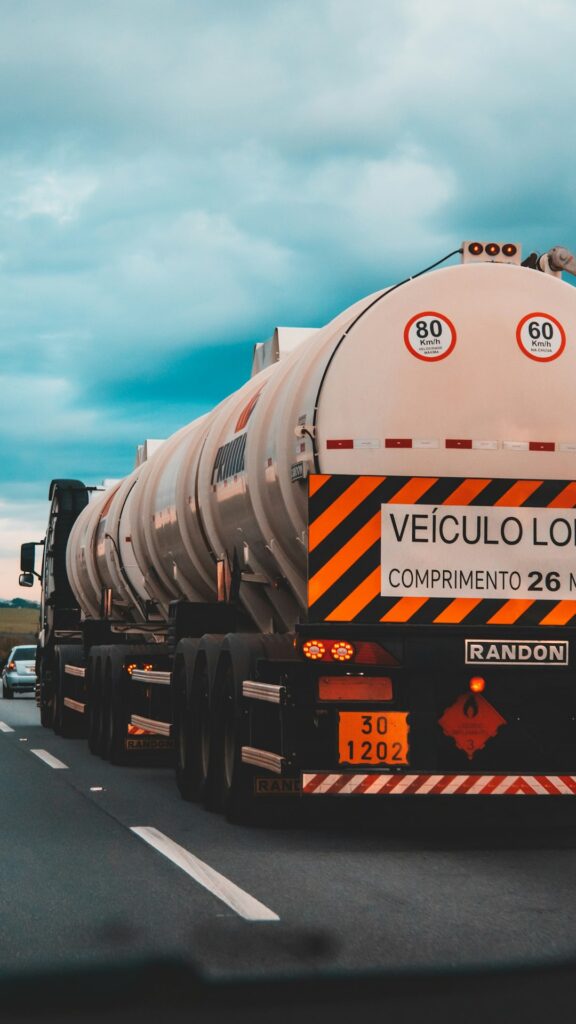
Are hazmat trucks rare in everyday traffic?
No. Hazardous materials move through communities every day by highway, rail, air, and water. A hazmat shipment may contain fuel, compressed gas, industrial chemicals, corrosives, medical materials, pesticides, or other regulated substances.
That does not mean every truck carrying a potentially harmful product is a tanker or has a large warning placard. Some materials travel in small packages, drums, cylinders, or specialized containers. Others may qualify for limited-quantity or small-shipment exceptions.
Residents may see these shipments on major roads, near commercial areas, or during deliveries to construction, manufacturing, agricultural, medical, and public-service operations. The presence of a hazmat vehicle is not, by itself, evidence of an emergency or unsafe driving.
Myth: Every hazardous material truck must display a placard
This is one of the most common misunderstandings. Placarding depends on the material, packaging, hazard category, quantity, and transportation conditions.
Many non-bulk shipments do not require placards when the total amount is below specific regulatory thresholds. Limited quantities and certain small shipments may also use different markings instead of the familiar diamond-shaped signs. In other cases, placards are required for any quantity because the hazard is especially serious, such as certain poisonous gases or inhalation hazards.
A vehicle without a placard is not necessarily carrying no regulated material. Conversely, a placarded vehicle is not automatically in danger. Placards are communication tools that help responders identify a general hazard during an incident.
Myth: A placard tells you exactly what is inside the truck
Usually, it does not. A placard generally identifies a hazard class, such as flammable liquid, corrosive material, radioactive material, or nonflammable gas. Some shipments also display a four-digit identification number on a placard, orange panel, or other approved marking.
The placard is designed to provide useful information from a distance, especially after a crash or spill. It is not a complete inventory and may not identify every product or package on the vehicle.
Emergency responders use placards along with shipping papers, container markings, driver information, and specialized response guides. Members of the public should not approach a vehicle to inspect labels more closely.
Myth: If a truck has no placard, the material cannot be dangerous
A material can still present a serious risk even when a placard is not required. Some shipments fall below placarding thresholds but remain capable of causing burns, poisoning, fire, environmental contamination, or dangerous reactions if damaged or mishandled.
Packaging requirements, labels, markings, shipping papers, training, and safe loading practices may still apply. The absence of a large sign means only that a particular placarding rule may not apply under those circumstances.
This distinction matters for household products as well. Gasoline, propane cylinders, pool chemicals, pesticides, paint products, aerosols, and strong cleaning substances may all create hazards when mixed, heated, punctured, or transported incorrectly.
Myth: All hazmat drivers need the same license and endorsement
Hazmat driving requirements depend on the vehicle and shipment. A commercial driver may need a hazardous materials endorsement on a commercial driver’s license, particularly when operating a commercial motor vehicle carrying material that requires placarding.
Additional requirements may apply for tank vehicles, passenger-carrying vehicles, or other specialized equipment. Drivers handling regulated shipments also need training appropriate to their responsibilities, including security awareness and emergency-response procedures.
Not every person moving a small amount of a hazardous product is operating under the same rules as a commercial hazmat carrier. For example, regulations recognize certain “materials of trade” transported in limited quantities to support a business. Those exceptions have conditions and quantity limits; they are not a blanket exemption for any business vehicle.
Myth: Household hazardous materials are regulated exactly like commercial freight
Private household transportation is treated differently from commercial transportation in many situations. A resident taking personal household hazardous waste to an authorized collection location is generally not treated the same way as a business offering hazardous material for transportation in commerce.
However, household products can still be dangerous. Containers should remain closed, upright, and secured so they cannot tip, leak, or move around. Different chemicals should not be combined in the same container or placed together if their labels warn against contact.
A product that is acceptable for ordinary household use may become more hazardous when transported in large quantities, placed in an unapproved container, exposed to heat, or mixed with another substance.
Myth: A hazmat truck accident always means the public should evacuate
Not every crash involving a hazmat vehicle produces a release or requires an evacuation. Emergency officials evaluate the material, container condition, weather, wind direction, fire risk, vapor behavior, nearby buildings, and the potential for exposure.
Residents should follow official instructions rather than making assumptions based only on the presence of a placard. Depending on the situation, officials may direct people to evacuate, shelter indoors, close windows, turn off ventilation systems, or avoid a specific area.
If an unknown substance is leaking, smoking, spreading across pavement, or producing an unusual odor, do not touch it or drive through it. Move away, stay uphill and upwind when possible, and call 911. Do not attempt to identify the substance by getting closer.
Myth: Odor is a reliable warning system

Some hazardous materials have strong odors, but others have little or no smell. Odor can also be misleading. A familiar smell does not prove that a substance is harmless, and the ability to smell something does not reliably indicate whether exposure is safe.
Weather conditions can affect how vapors move. Warm temperatures may increase vapor formation, while wind can carry a substance beyond the immediate location. In a densely developed area, buildings, traffic, drainage systems, and enclosed spaces can influence where a release travels.
That is why residents should rely on distance, official instructions, and emergency responders rather than personal observation alone.
Myth: Hazmat transportation is governed only by federal rules
Federal hazardous materials regulations form the main framework for transportation in commerce, but safety also involves state and local emergency planning, fire response, roadway enforcement, environmental protection, and public safety procedures.
In Illinois, a hazardous materials incident may involve emergency management, fire and law-enforcement personnel, environmental responders, transportation officials, and specialized cleanup teams. A release affecting a roadway, drainage area, soil, or waterway may require environmental reporting and coordinated containment.
Local residents do not need to know every regulatory detail to respond safely. The most useful actions are practical:
- Keep a safe distance from spills, damaged containers, smoke, and vapor clouds.
- Avoid touching packages or debris from a crash.
- Do not use road shoulders or drive around barricades to get a closer look.
- Follow evacuation or shelter instructions promptly.
- Report visible releases or immediate danger through 911.
Myth: Safe hazmat transportation means accidents never happen
Safety rules reduce risk, but no transportation system can eliminate every possibility of a crash, mechanical failure, loading error, severe storm, or unexpected release.
The safety system is built around layers: proper classification, packaging, labeling, vehicle inspection, driver training, route planning, shipping papers, emergency information, enforcement, and coordinated response. Each layer is intended to help prevent an incident or reduce its consequences.
Seasonal conditions can add complications. Winter freezing, summer heat, heavy rain, reduced visibility, and slick pavement can affect driving and cargo handling. Residents can help by giving large trucks adequate space, avoiding sudden lane changes, and never stopping near a crash involving a marked hazardous material vehicle unless directed by authorities.
Knowing what placards mean is useful, but recognizing when to keep away and wait for trained responders is even more important.